

I Found a Bug on Line 673 That Would Have Leaked Credit Card Numbers. Then I Built a Programming Language.
AI generates code 100x faster than we can review it. The math doesn't work. Here's what I'm doing about it.

847 lines of AI-generated code. Payment processing. Looked perfect. Passed every test.
Line 673 would have leaked credit card numbers to the logs.
I almost shipped it. It was 2 AM. I was tired. I only caught it because I’d seen this exact bug kill a startup three years ago.
That night I did the math on AI code generation. The numbers broke my brain.
The Math That Should Terrify You
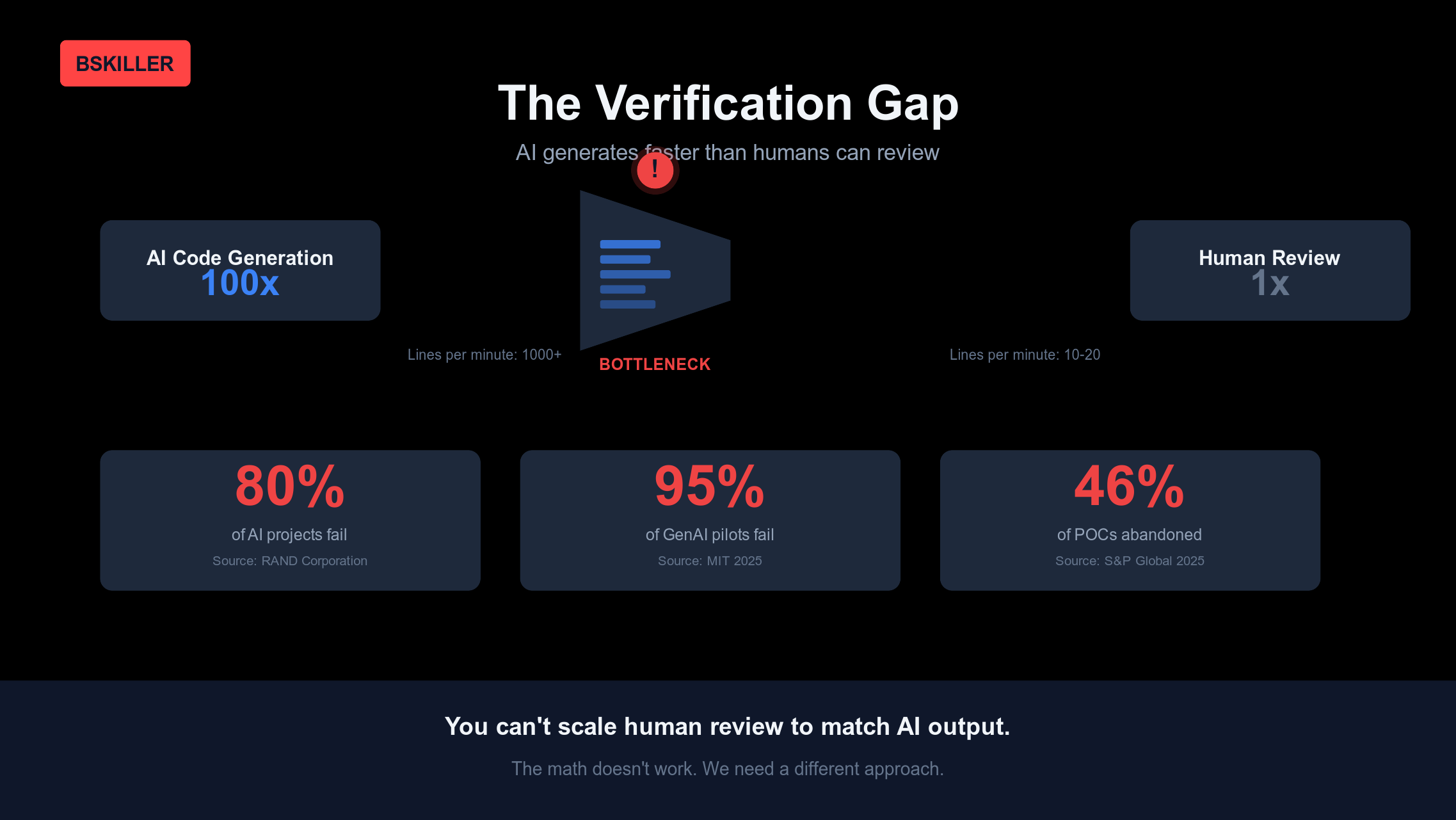
AI generates code at 100x human speed.
We review code at 1x human speed.
You see the problem.
The receipts:
RAND Corporation: 80% of AI projects fail
MIT 2025: 95% of GenAI pilots never deliver business value
S&P Global 2025: 46% of POCs abandoned before production
Everyone’s talking about AI coding tools. Nobody’s talking about verification.
The gap between “AI generates code” and “humans verify code” is growing exponentially.
Every. Single. Week.
What If Code Could Prove Itself?
Here’s the idea that wouldn’t let me sleep:
What if the code came with mathematical proof that it works?
Not tests. Tests miss edge cases. Not code reviews. Reviews depend on whether you’ve had coffee.
Actual mathematical proof. The kind where if the proof fails, the code literally cannot compile.
This isn’t science fiction. It’s called formal verification. Languages like Coq, Lean, and Dafny have done it for decades.
The problem? They’re academic. Complicated. Require PhD-level expertise. Unusable for real software.
So I started building something different.
The First Nova Program
February 3rd, 2025. 2:47 AM.
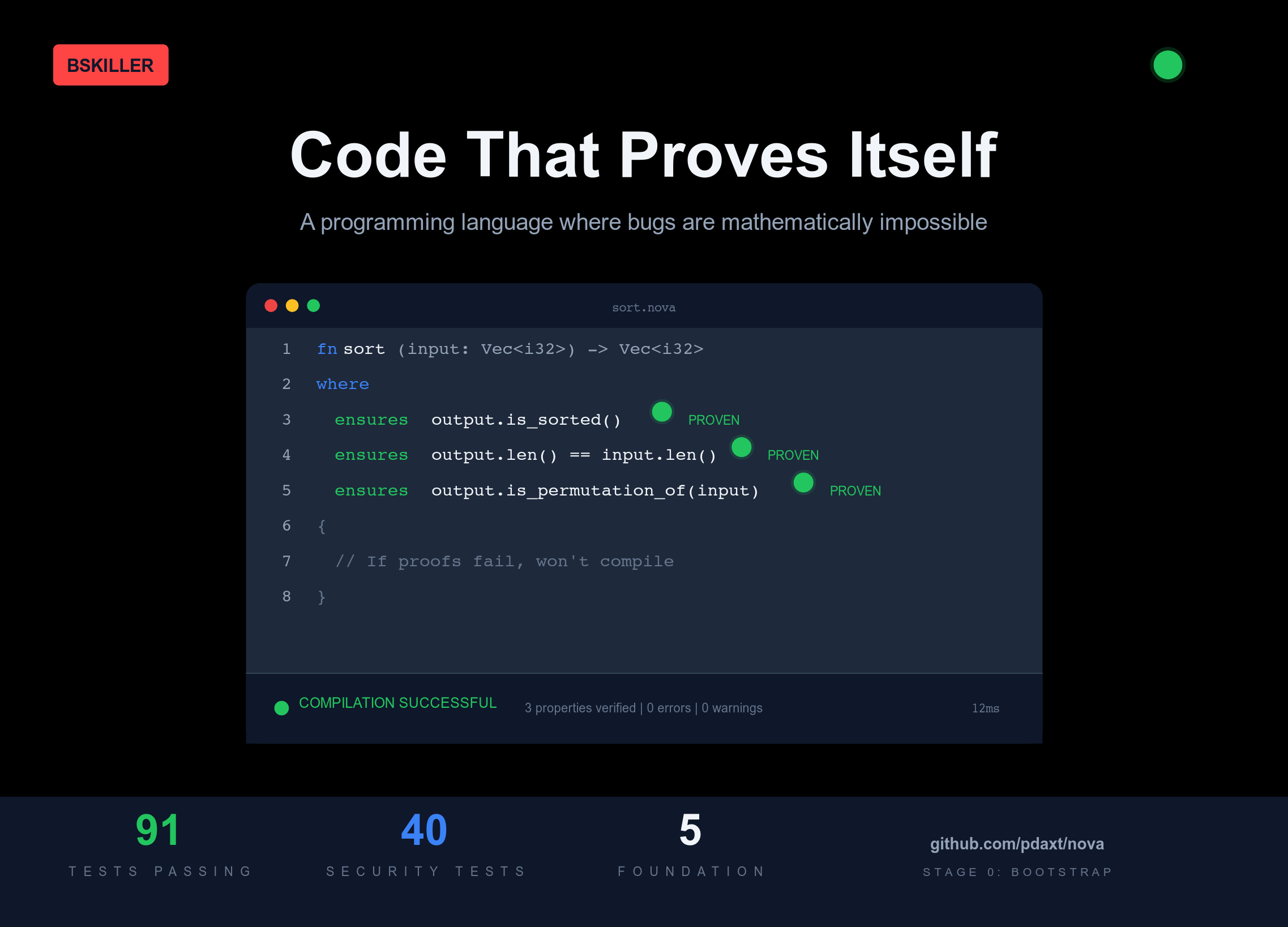
fn sort(input: Vec<i32>) -> Vec<i32>
where
    ensures output.is_sorted(),
    ensures output.len() == input.len(),
    ensures output.is_permutation_of(input)
{
    // implementation
}
Look at those three lines after where.
