

Your 2026 AI Career Survival Guide: What to Learn, What to Ignore, and What Will Get You Promoted

While you were on holiday, the rules of your career changed.
Four AI companies dropped their most powerful models yet. In 25 days. GPT-5.2. Claude Opus 4.5. Gemini 3. Grok 4.1.
Most people scrolled past. “Cool. Another model.”
Those people are about to get left behind.
Here’s what they missed: 95% of people playing the AI game are about to lose. And most don’t even know it yet.
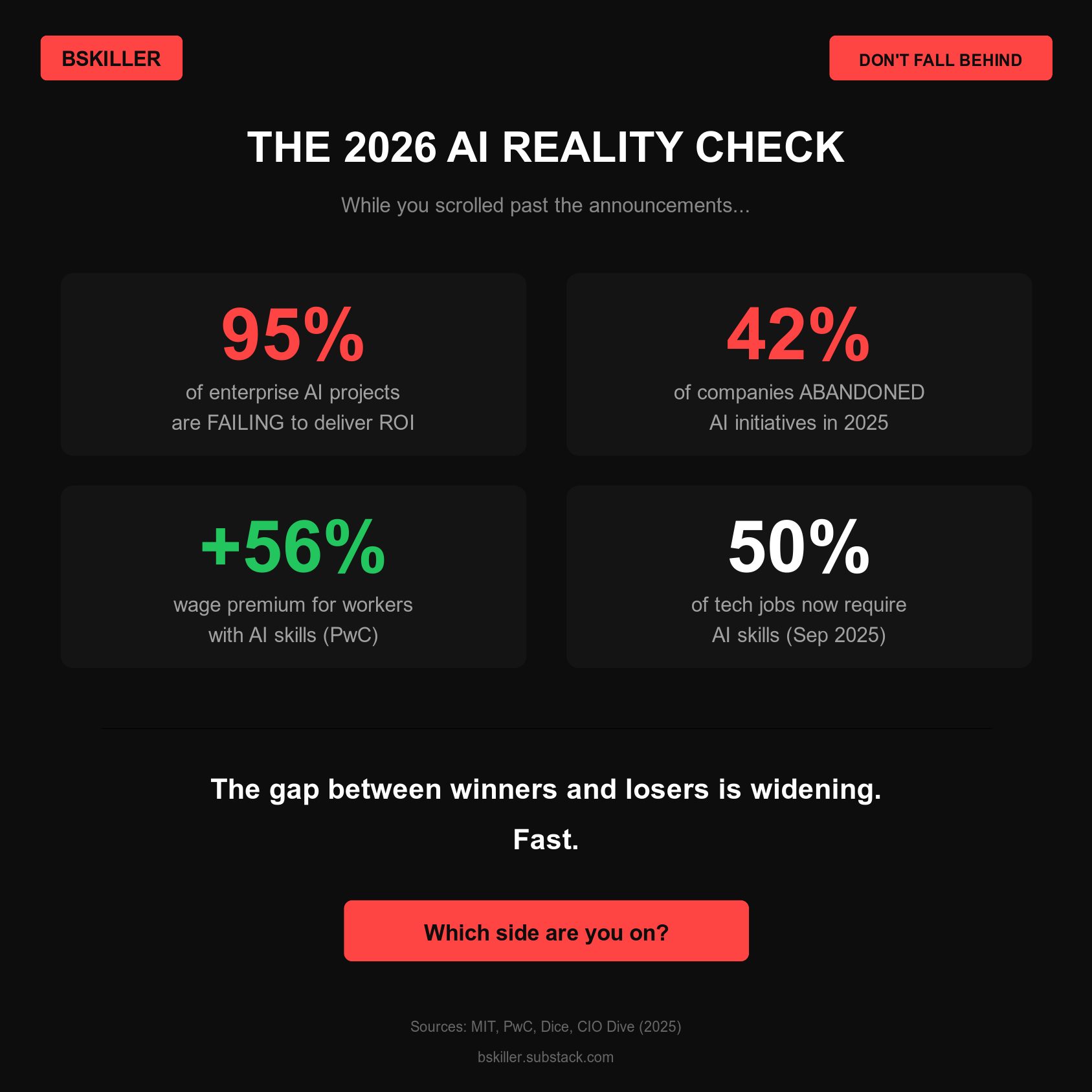
That’s not hyperbole. That’s MIT’s finding: 95% of enterprise AI projects are failing to deliver any business return. 42% of companies abandoned their AI initiatives entirely in 2025, up from 17% the year before.
The gap between people who get AI right and people who waste time on it is widening. Fast.
This isn’t a post about which model is best. You can find that anywhere. This is about what these shifts mean for YOUR career in 2026, and what to do about it.
Shift 1: AI Skills Are No Longer Optional
Here’s a number that should make you uncomfortable: 50% of all U.S. tech job postings now require AI skills.
As of September 2025. Up from 47% just one month earlier.
But that’s the obvious part. Here’s what’s not:
According to McKinsey’s latest workforce research, the number of workers in jobs where AI fluency is explicitly required has grown sevenfold in two years. From 1 million in 2023 to 7 million in 2025. That’s the fastest-growing skill category in U.S. job postings.
The wage premium? 56% higher for workers with AI skills, according to PwC’s 2025 Global AI Jobs Barometer. More than double the 25% premium from the previous year.
What this means for YOUR career:
If you’re technical: AI knowledge isn’t a differentiator anymore. It’s table stakes. The people getting promoted and commanding premium salaries? They’re specialists, not generalists. They picked a lane and went deep.
If you’re not technical: This is actually your moment. Companies are desperate for “AI translators”, people who can explain AI to executives without the jargon. That doesn’t require coding. It requires understanding what AI can and can’t do. And that’s exactly what I’m going to show you.
Shift 2: The Hype Correction Is Real (Finally)
MIT Technology Review called 2025 “The Great AI Hype Correction.”
Here’s why that matters for you:
Companies spent $30-40 billion on generative AI. 95% saw no business return. The MIT report found that only 5% of AI pilot programs achieved rapid revenue acceleration.
Where did the money actually work? Not where everyone expected.
More than half of GenAI budgets went to sales and marketing tools. But MIT found the biggest ROI in back-office automation. Eliminating business process outsourcing. Cutting external agency costs. Streamlining operations. The boring stuff.
Meanwhile, RAND Corporation’s analysis confirmed that over 80% of AI projects fail. That’s twice the failure rate of non-AI technology projects.
What this means for your career:
The person who says “AI isn’t the right solution for this” will be more valuable than the person who tries to shove AI into everything.
Be the one who knows where AI actually works, not just where it sounds impressive. In 2026, that’s a competitive advantage.
Shift 3: The Consolidation Has Begun
Something else happened in December that didn’t make headlines: The Linux Foundation announced the Agentic AI Foundation.
Anthropic’s Model Context Protocol. Block’s goose. OpenAI’s AGENTS.md. All donated to a neutral foundation. Major players, including Microsoft, AWS, Google, Bloomberg, and Cloudflare, are rallying around shared standards.
Why does this matter?
Because the wild west phase is ending. AI agents are becoming a real category. And the companies that figure out how to build, manage, and secure them will win.
The most in-demand specialized skill right now? LLM fine-tuning. Companies are moving beyond generic ChatGPT integrations toward custom models trained on their own data. Engineers who can do this command 30-50% salary premiums over generalists.
Emerging areas showing strong signals: Multi-modal AI. AI agents and autonomous systems. Edge AI. AI security. Synthetic data generation.
What this means for your career:
Stop learning tools. Start learning patterns.
The specific model doesn’t matter. They’ll change. What matters is understanding how to evaluate models, when to fine-tune vs. prompt, how to build reliable agent systems, and where the security gaps are.
Your 2026 Playbook
If You’re Not Technical
You don’t need to code. You need to understand.
Learn these three things:
How to evaluate AI claims. When a vendor says “95% accuracy,” know what questions to ask. (What’s the test set? What’s the failure mode? Can I talk to a production customer?) This makes you invaluable in meetings.
Where AI actually works. Back-office automation. Document processing. Customer service triage. The boring use cases with clear ROI. Not the flashy demos that fail in production.
How to brief leadership on AI. Someone needs to translate between technical teams and executives. Companies are actively recruiting for this skill. It doesn’t require a CS degree.
Ignore these:
Learning to code “because of AI.” If you don’t enjoy coding, you’ll quit. Focus on what you’re good at.
The latest model announcements. GPT-5.2 vs. Claude Opus 4.5 doesn’t affect your daily work.
Fear-mongering about job replacement. The people being replaced are the ones who refuse to adapt, not the ones actively learning.
If You’re Technical
The generalist premium is gone. Specialization pays.
Double down on these:
LLM fine-tuning and evaluation. This is the highest-demand skill right now. Not just running fine-tuning jobs, but knowing when fine-tuning makes sense vs. prompt engineering vs. RAG.
Agent architectures. AI agents went from buzzword to real category in 2025. The agentic AI foundation forming around MCP signals where the industry is heading. Learn the patterns.
AI security. Prompt injection. Data poisoning. Model extraction. The attack surface is expanding and the talent pool is tiny. AI security is emerging as a top skill for 2026.
Skip these (for now):
Yet another framework. LangChain, CrewAI, AutoGen... the abstraction layer is still in flux. Learn the underlying patterns.
Building your own foundation model. Unless you have $100M and a team of 50, you’re fine-tuning existing models.
Chasing benchmarks. Real production performance rarely matches benchmark claims.
If You’re a Manager or Leader
You’re going to be asked to make AI decisions this year. Maybe you already have been.
The three questions you need to answer:
Build, buy, or wait? According to MIT research, 67% of successful AI implementations come from purchasing specialized tools or building vendor partnerships. Internal builds succeed one-third as often. Know when to wait.
Where’s the actual ROI? Hint: probably not where the sales pitch says. MIT found the biggest returns in back-office automation. Not customer-facing chatbots. Not flashy demos.
How do you measure failure? 42% of companies abandoned AI initiatives in 2025. Most didn’t have clear success criteria. Define what “working” looks like before you start.
The Bottom Line
2026 is the year AI stops being optional for your career.
Not because AI will replace your job. That’s the fear-mongering narrative. The real threat is simpler: the people who understand AI, who can separate signal from noise, who know where it works and where it’s BS, those people are going to take the promotions, the raises, and the opportunities.
While everyone else drowns in hype.
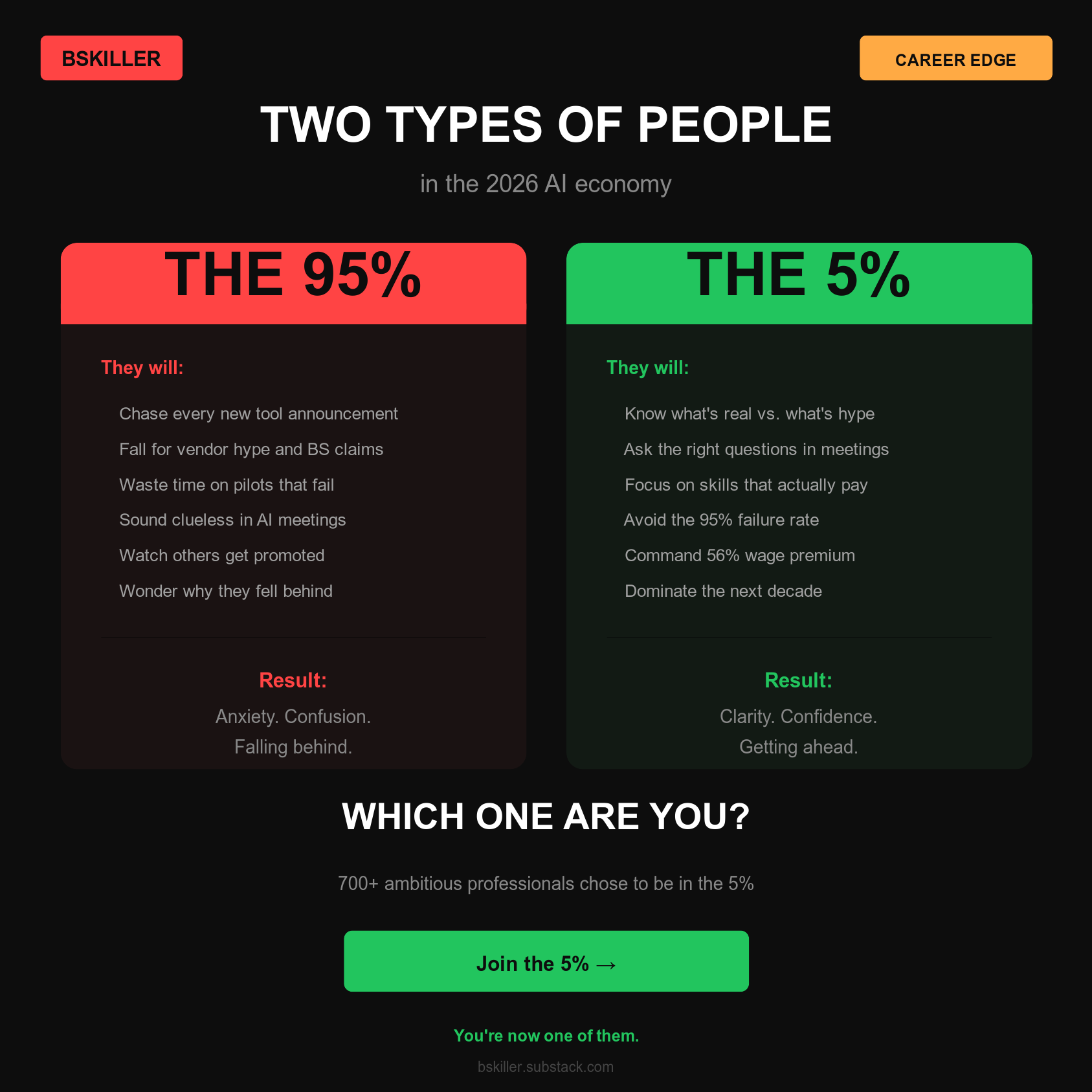
The 95% will keep chasing every new tool announcement. They’ll fall for vendor BS. They’ll waste time on pilots that go nowhere. They’ll sound clueless in meetings. They’ll watch from the sidelines as others get ahead.
The 5% will know exactly what’s real. They’ll ask the questions that make them look smart. They’ll avoid the traps. They’ll get promoted.
Which one are you?
What BSKiller Delivers in 2026
Every week, while the 95% drown in noise, you’ll get:
Career intelligence. What AI developments actually mean for YOUR job. Not theory. Not hype. What you need to know to get ahead.
BS detection. I call out the claims that are garbage so you don’t waste time or credibility on them. With receipts.
Practical paths. What to learn next, whether you’re technical or not. No CS degree required.
Production reality. What’s actually working in production, what’s failing, from someone who deploys AI systems for enterprises daily.
700+ ambitious professionals refuse to fall behind. They’re using BSKiller to make smarter AI decisions at work, avoid the hype traps that cost others their credibility, and stay ahead while everyone else chases the next shiny announcement.
For AI Practitioners Who Refuse to Fall Behind
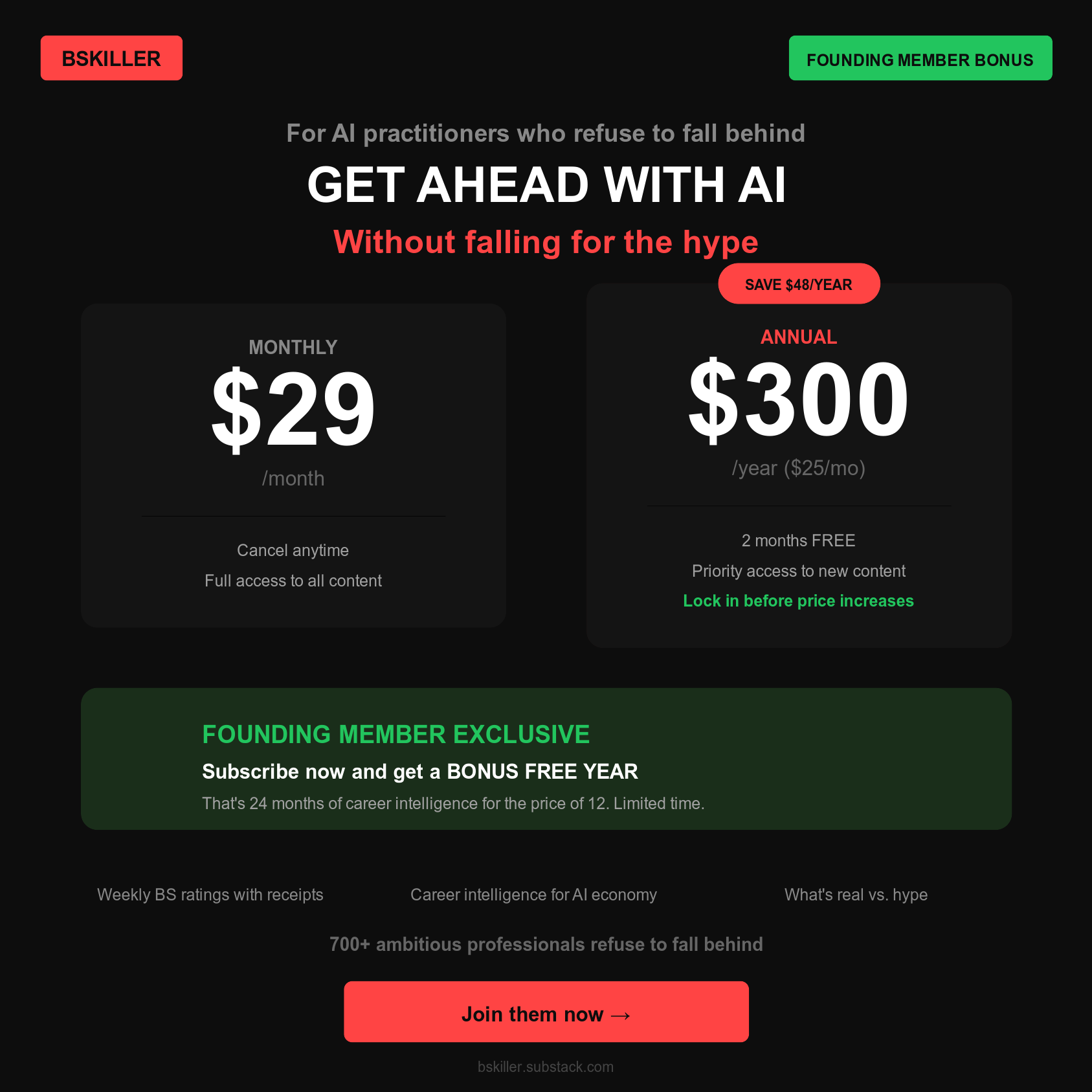
Monthly: $29/month. Cancel anytime.
Annual: $300/year ($25/month). Save $48.
Founding Member Bonus: Subscribe now and get a BONUS FREE YEAR. That’s 24 months of career intelligence for the price of 12. This won’t last.
The gap is widening every day. The people who get it are pulling ahead. The people who don’t are falling behind. There’s no middle ground anymore.
Join the 700+ who chose to be in the 5%.
P.S. You just read 2,000+ words of career intelligence that most people will never see. That’s the kind of value I deliver every single week.
The people who understand AI reality are going to dominate the next decade. You’re now one of them.
Welcome to the 5%.
Sources
MIT Report: 95% of GenAI Pilots Failing - Fortune, August 2025
42% of Companies Abandoned AI Initiatives in 2025 - CIO Dive, 2025
50% of Tech Jobs Now Require AI Skills - Dice, 2025
AI Skills 7x Growth - McKinsey, 2025
56% Wage Premium for AI Skills - PwC 2025 Global AI Jobs Barometer
The Great AI Hype Correction of 2025 - MIT Technology Review, December 2025
Top AI Engineering Skills and Salary Ranges 2026 - Second Talent, 2026
RAND: Root Causes of AI Project Failure - RAND Corporation
Agentic AI Foundation Launch - Linux Foundation, December 2025
AI Translators as Emerging Role - CBS News