GET THE AUTOPSY ➔

OpenAI just announced the number that proves it will miss its own target.

A single month of ad revenue, times twelve, dressed up as a billion-dollar milestone.
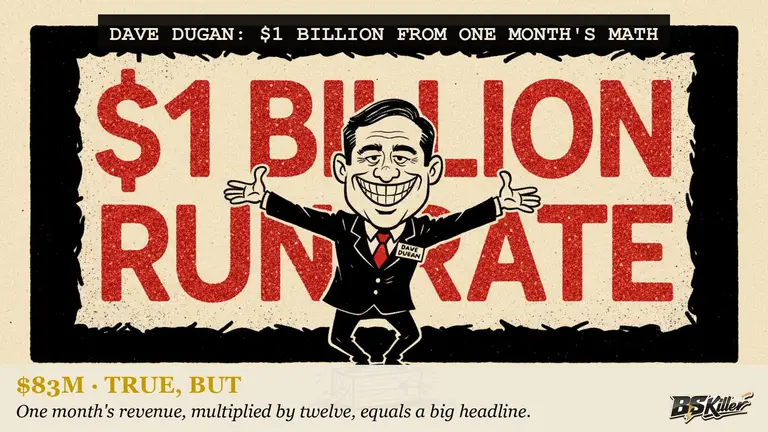
01THE CLAIM
"OpenAI's ChatGPT advertising operation has crossed $1 billion in annualized revenue run rate, just six months after launch." [SOURCE ↗]
TRUE, BUT4 SOURCES · LIVE 2026-08-25
OPENAI TRACK RECORD33 CLAIMS · 39/100 BS RATE →
$83MACTUAL MONTH BEHIND IT
x12THE MULTIPLIER
200DAYS SINCE LAUNCH
$2.5BOPENAI'S OWN 2026 TARGET
OpenAI just announced the number that proves it will miss its own target.
02THE CHECK

THE CLAIM. OpenAI says its ChatGPT ad business hit "$1 billion in annualized run rate" in under 200 days. THE CHECK: that figure is one month of actual ad revenue, about $83 million, multiplied by twelve. Not money collected. Not money billed. A snapshot, annualized, from a footprint that just expanded with the same announcement (Europe self-serve access went live the same day). THE TWIST: OpenAI's own 2026 target is $2.5 billion in real ad revenue. Eight months into the year, the milestone it chose to publicize is the same math that shows it is pacing at roughly a billion, well short of its own goal.

03SAY THIS IN THE MEETING · 📸 SCREENSHOT IT
"That's not a billion dollars. That's one good month, times twelve, eight months into a year they said would make two and a half billion."
DEEP DIVE · THE FULL AUTOPSY

What actually happened

On August 31, 2026, OpenAI announced that its ChatGPT advertising business had crossed "$1 billion in annualized revenue run rate," a milestone it says arrived under 200 days after the ad unit launched in February. VP of Global Ad Solutions Dave Dugan called it proof of "the scale of the opportunity ahead," and framed OpenAI as opening "a new chapter for advertising." The same announcement rolled out self-serve ad access to businesses in Europe, expanding the geographic footprint of the ad product on the exact day the milestone was published.

Digiday, one of the few outlets to actually explain the arithmetic, confirms what "run rate" means here: OpenAI's current monthly ad revenue, reported at roughly $83 million, multiplied by twelve. That is standard practice for reporting a young business's trajectory. It is also, definitionally, not a billion dollars OpenAI has earned. It is one month, annualized.

Why we rate this needs_context

The number is not fabricated. OpenAI is not claiming to have collected a billion dollars, and to its credit, Digiday's coverage states the methodology plainly. The problem is what happens after that: PYMNTS and SiliconANGLE reprinted the "$1 billion" headline with zero mention of the run-rate math, which is where the framing does its real work. A reader skimming headlines walks away thinking OpenAI's ad business is now a billion-dollar operation. It made $83 million last month.

eMarketer analyst Nate Elliott put the sharper version on the record the same day: "This announcement is both incredibly impressive and terribly disappointing," pointing out that OpenAI is "just now hitting a $1 billion run rate, rather than actual revenue, eight months into the year" it set out to hit $2.5 billion in actual ad revenue. Elliott's math is blunt: at the current pace, hitting that target by year-end is close to impossible. Adweek independently confirmed the same gap, stating plainly that ChatGPT "has not yet generated over $1 billion in annual advertising revenue but is on track to do so."

The steelman, and why it still needs context

The fair version of OpenAI's case: a run rate is a legitimate, widely used way to communicate momentum in a fast-growing business, and every ad platform from Meta to TikTok has used the same convention at some point. Announcing a trajectory isn't lying. That's true as far as it goes. But the base being annualized here just changed, Europe's self-serve rollout landed the same day as the milestone, meaning the $83 million month reflects an inventory footprint that didn't exist for most of those 200 days. Annualizing a number that is itself mid-expansion compounds the optimism twice over.

The mechanism

Run-rate announcements are a genre now. They let a company publish a headline number that sounds like an achieved outcome while actually describing a projection built on the best recent data point available. The tell is always the same: the announcement leads with the annualized figure and buries, or omits, the trailing actual. OpenAI's own $2.5 billion target for 2026, an achieved-revenue goal, not a run rate, sits right next to the $1 billion run-rate figure in the same release. Read together, they say the opposite of what the headline implies.

What to do with this

  • Whenever an AI company reports a "run rate," ask for the trailing period behind it before treating the number as revenue earned.
  • Watch OpenAI's actual year-end ad revenue against its own $2.5 billion target. If it lands meaningfully short, the August 31 announcement was the tell, not the milestone.
  • Treat any run-rate figure published in the same window as a footprint expansion (a new market, a new ad format, a new tier) as doubly optimistic, since the base itself is not stable.
04YOUR MOVE ⚡ WHAT IGNORING THIS COSTS

Every AI company now reports "run rate" instead of revenue, and readers keep treating the two as interchangeable. If you are sizing up any AI company by its headline number, ask what single period got multiplied by twelve before you repeat it.

05🔮 OUR CALL · ON THE RECORD 2026-09-01

OpenAI will not disclose actual trailing (non-annualized) ad revenue before year-end 2026, and when full-year numbers surface, ad revenue will land short of the $2.5B target.

OpenAI publishes actual trailing ad revenue, not a run rate, showing it on pace to hit or beat $2.5B for the year.

RECEIPTS (4) · CONFIDENCE HIGH · every URL below answered a live HTTP check before publish · sweep 2026-08-25

  • digiday.com · "multiplying current monthly ad revenue by 12, so it's a snapshot of where things stand today rather than money already booked"
  • mediapost.com · "If they're just now hitting a $1 billion run rate -- rather than actual revenue -- eight months into the year"
  • adweek.com · "has not yet generated over $1 billion in annual advertising revenue but is on track to do so"
  • siliconangle.com · "The ads appear for ChatGPT Go subscribers and free-tier users directly within the model's responses to questions"

This story is a stable, citable object. If you can falsify a verdict, tell us. Corrections are loud here.