Bill Gates says AI will be very bad for the job market and wants a robot tax to slow it down.
Jensen Huang says he loves Bill, but does not see what Bill sees. Neither man shows a single number.
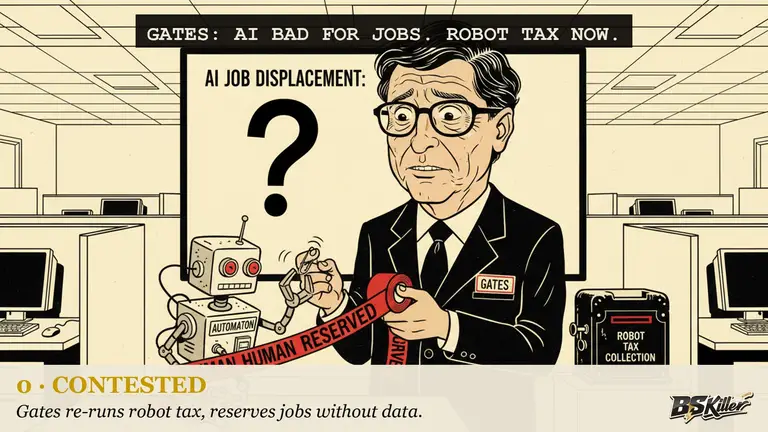
Bill Gates published an essay warning AI will be very bad for the job market and proposing a robot tax and legally protected 'Human Reserved' jobs. Jensen Huang publicly rejected that view three days later, calling AI a net job creator at a scale never seen before.
Before you read on. Your call?
CONTESTED
0
both statements are confirmed, on the record, from named billionaires. Neither one comes with a quantified figure, a percentage, or a date. TechCrunch's and Fox Business's full coverage of both men confirms the absence of hard numbers on either side.
The twist
Gates floated a nearly identical robot tax in 2017, and economists dismissed it then as a tax on productivity dressed up as a tax on progress, this is not a new argument updated with new evidence, it is the same argument re-run nine years later with the word AI swapped in.
There’s more to this story.
Membership opens the full investigation, the strongest counterargument and what to do with what you’ve learned.
30 days free, then A$89 a year. Payment card required. Cancel before the trial ends to avoid the first charge.
Review my 30-day free trial →- At sign-up: 30 days free. Payment card required. One introductory trial per customer.
- Your trial ends 30 days after you start. Unless you cancel before then in Account → Manage subscription, we charge A$89 for the first year. It renews automatically at A$89/yr until cancelled.
- You can ask for a full refund within 14 days after any annual payment, renewals included, with no reason needed, by emailing [email protected]. This voluntary refund does not limit your rights under the Australian Consumer Law.
By starting your trial, you agree to the Terms.
BS Killer is published by Inferno Tech Pty Ltd, ABN 27 647 413 474.
Get tomorrow’s check free by email.
Couldn't check your access. That's on us.
Receipts
- Supports techcrunch.com:
The tax system nudges you toward replacing people with machines
- Context thenextweb.com:
He first proposed taxing robots in February 2017, when the argument was about factory automation rather than models, and the reasoning was the same
- Refutes finance.yahoo.com:
I love the heck out of Bill, Huang told Fox Business this week
Open the Receipts Pack → What each source proves, every figure traced, and what would change our verdict.